
The Art of Imperfection: Wabi-Sabi and the Beauty of Natural Materials
When Imperfection Becomes Beautiful
We live in a strange moment. Our homes are more photographed than ever, yet somehow less lived-in. Every surface is styled, every shelf color-coordinated, every corner optimized for a camera angle it will probably never see. Somewhere in the pursuit of the “perfect” interior, a lot of us lost the feeling of actually being at home.
This is exactly where Wabi-Sabi interior design offers something different. It doesn’t ask you to chase flawlessness. It asks you to notice what’s already beautiful in the uneven, the weathered, the handmade. A knot in a wood grain. A slightly irregular seam. A surface that shows, rather than hides, how it was made.
So what happens when we let natural materials and human fingerprints back into our homes? At RainDow Art Studio, this question shapes almost everything we create. We’re not a traditional Japanese craft house, and we don’t claim to be. But the spirit of Wabi-Sabi — the honesty of materials, the quiet confidence of imperfection — runs through every wall hanging we make by hand.
The Three Core Ideas
Strip away the aesthetic references and you’re left with three simple, very human ideas:
Impermanence — things change, age, and wear with time, and that process is part of their value, not a threat to it.
Imperfection — an object doesn’t need to be flawless to be worth keeping or admiring.
Simplicity — beauty doesn’t require excess. Often it needs the opposite.
Everyday Examples
You’ve already experienced Wabi-Sabi, even if you never named it. The grain running through a wooden tabletop, no two lines alike. A hand-thrown ceramic mug with a slightly uneven rim. A linen shirt that softens and creases in its own particular way over the years. None of these are mistakes. They’re evidence that something real made contact with the object — a tree, a hand, time itself.
Wabi-Sabi in Modern Interior Design
From Polished Showrooms to Lived-In Spaces
Interior design has spent decades chasing the showroom look — symmetrical, glossy, reproducible at scale. Wabi-Sabi pulls in the opposite direction. It favors rooms that feel inhabited rather than staged, where objects carry a bit of history instead of looking freshly unwrapped.
Natural Materials as a Design Language
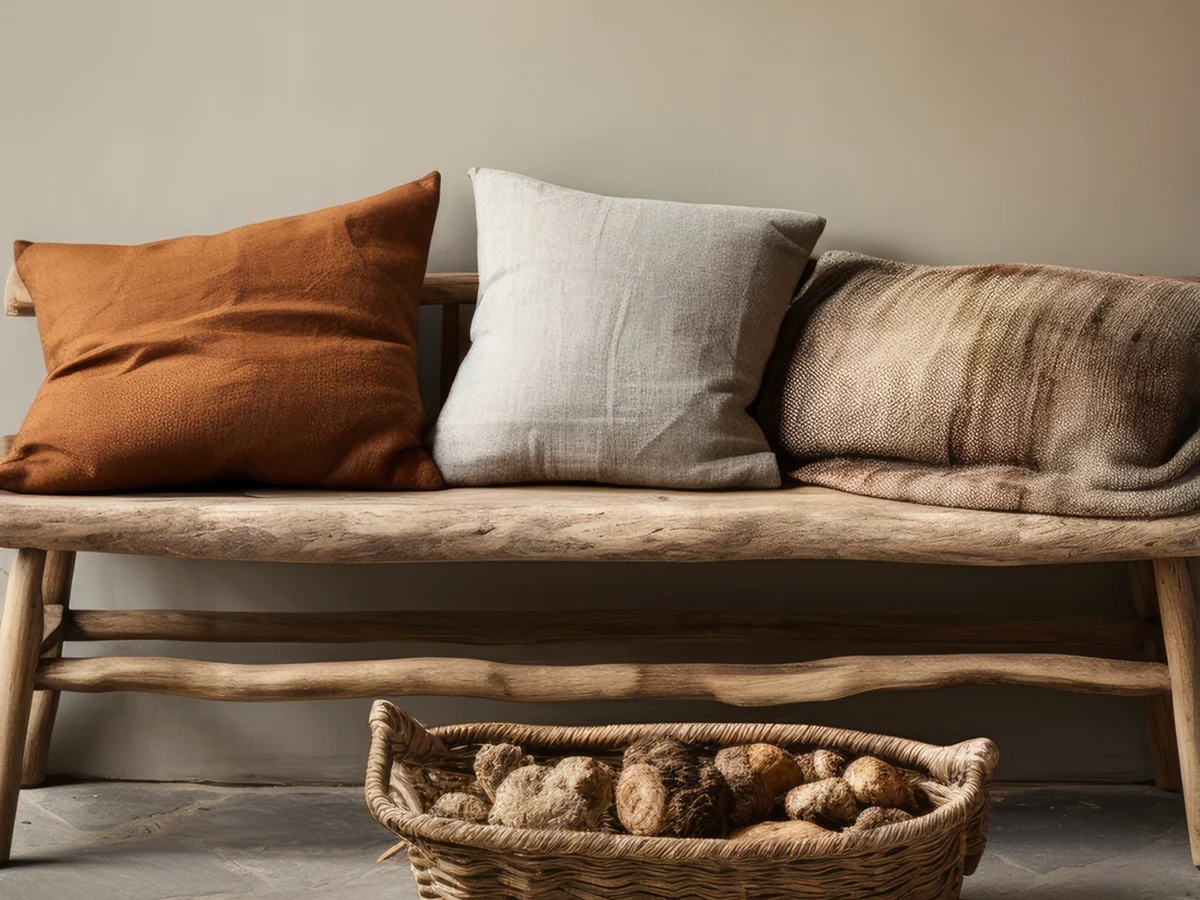
This is where natural materials in interior design stop being a mere trend and start functioning as an actual visual language. Wood, linen, raw cotton, stone, unglazed ceramic — these materials speak in texture and irregularity rather than uniformity. Each grain pattern, each woven thread, tells you something was grown or made rather than manufactured to spec.
Sensory Calm and Visual Depth
There’s a practical reason this approach resonates: natural textures create sensory calm. A room built entirely from smooth, uniform surfaces can feel visually flat, almost sterile. Introduce a raw wood edge or a textured woven piece, and suddenly there’s depth — something for the eye (and often the hand) to settle into.
A Clarification Worth Making
Wabi-Sabi home decor doesn’t mean empty rooms or a refusal of modern design. It’s not extreme minimalism, and it isn’t anti-architecture. It coexists comfortably with clean modern lines, contemporary furniture, and considered art. In fact, the contrast often makes both elements stronger — a raw, organic piece against a crisp, modern wall does more visual work than either would alone.
Why This Philosophy Matters Today
Mass Production Meets Curated Feeds
We’re surrounded by mass-produced objects and algorithm-curated images of “ideal” homes. Everything starts to look faintly interchangeable after a while — the same furniture silhouettes, the same neutral palettes, repeated across a thousand feeds.
The Desire for Real, Tactile Objects
Against that backdrop, there’s a growing hunger for objects that feel real. Something you can run your fingers across and feel an actual texture, not a printed approximation of one. This is part of why handmade wall art and textured wall art have found renewed appeal — they offer a tactile counterpoint to a very flat, very digital visual diet.
Imperfection as Character
A perfectly uniform object tells you nothing about itself. A piece with visible grain, an asymmetrical branch, or an intentionally raw fabric edge tells you a small story — where the material came from, how it was shaped, whose hands were involved. That’s not a flaw to be corrected. It’s character.
From Decoration to Emotional Connection
This is ultimately what separates decoration from connection. A mass-produced print fills a wall. A handmade piece with real material presence can actually mean something to the person living with it — a quiet daily reminder that not everything needs to be smoothed into sameness.
Our Approach at RainDow Art Studio
This philosophy isn’t something we talk about from a distance. It’s built into how every piece leaves our studio.
Inspiration, Not Imitation
We want to be clear about something: RainDow doesn’t produce traditional Japanese Wabi-Sabi objects, and we don’t claim that heritage. What we do is draw inspiration from its core values — material honesty, acceptance of natural variation, and respect for the handmade — and apply them to our own contemporary wall art.
The Character of Real Wood
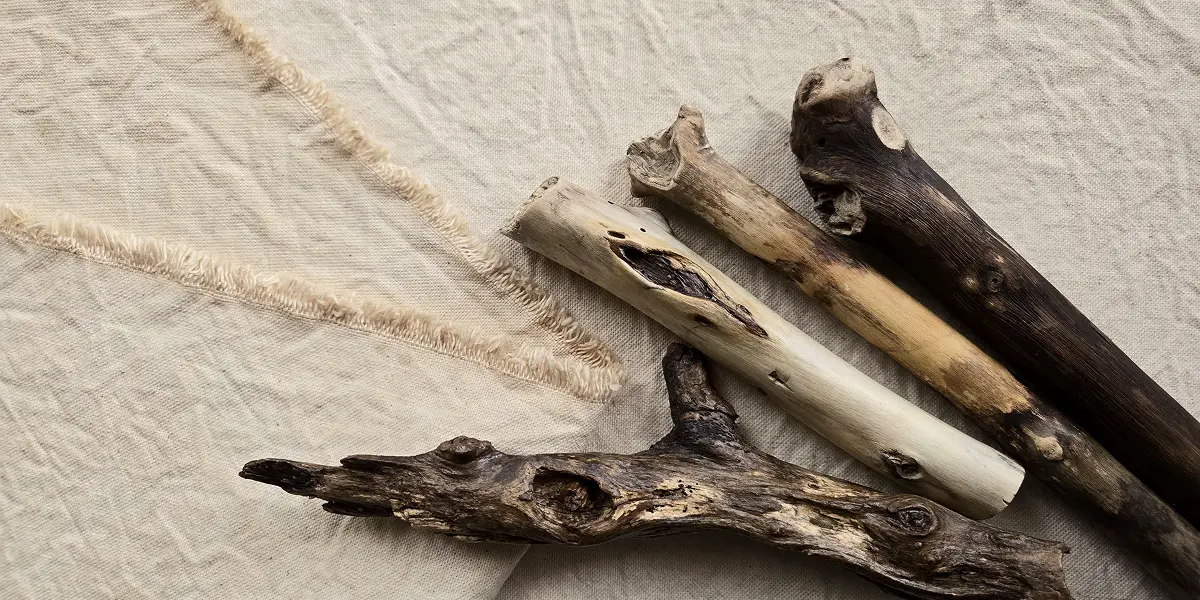
Every branch we use is naturally collected, not milled to a uniform spec. This means knots stay in. Curves stay uneven. Bark texture stays visible where it makes sense to. We treat the wood minimally, just enough to prepare it for the piece, without sanding away the organic shape that made us choose that branch in the first place.
The Texture of Fabric
Alongside the wood, we work with raw canvas and natural fabric, chosen for how the weave catches light and holds texture under the hand. These aren’t smoothed-out, uniformly printed surfaces — they carry the slight irregularity of natural fiber, which is exactly the point.
Where Nature Meets the Handmade
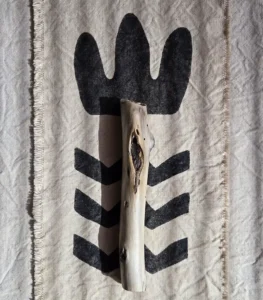
The most interesting moments in our work happen at the meeting point of contrasts: hard branch against soft fabric, rigid structure against organic curve, raw material against deliberate composition. That tension is where a piece starts to feel alive rather than merely decorative.
Concepts Behind the Pieces
Our collections often return to a few recurring themes — growth, celestial imagery, femininity, and quiet, still moments. These aren’t abstract concepts chosen for a mood board. They’re the natural outcome of working with organic materials that already suggest movement, cycles, and softness.
Subtle Variations Are a Feature
Because every branch and every length of fabric is unique, no two RainDow pieces are perfectly identical, even within the same design. We consider this a feature, not an inconsistency to correct. It means the piece hanging in your home is genuinely one of a kind — shaped by the same natural variation that made a Wabi-Sabi philosophy compelling in the first place.
Wabi-Sabi as Inspiration for “Art for Living”
We think of what we make as art for living, not art for display. The difference matters. Art for living doesn’t ask to be the centerpiece of a curated moment — it exists quietly alongside your daily routines, present but unobtrusive. It’s there while you make coffee, while you work, while the light shifts across the room throughout the day. Its value isn’t in demanding attention; it’s in offering a small, steady sense of presence.
Let Imperfection In
Natural variation is what gives an object identity. A perfectly uniform piece can be replaced without anyone noticing. A piece shaped by real wood grain, real weave, and real hands cannot — it belongs specifically to itself, and by extension, to wherever it hangs.
If this way of thinking about materials and craftsmanship resonates with you, we’d love for you to explore RainDow Art Studio’s handcrafted wall art collection. Each piece carries its own natural character — imperfect in exactly the way that makes it worth keeping.